TIPS taxes and phantom income
In a taxable account, a TIPS can create reportable income in two forms: coupon interest paid in cash and an inflation adjustment added to principal. The second can be taxable before you receive that principal in cash. That timing difference is commonly called phantom income.
The IRS's inflation-indexed debt rules explain the principal adjustment. Use the tax-year edition that applies to your return; the editions reviewed here are Publication 550 (2025) and Publication 1212 (December 2025).
A hypothetical year, step by step
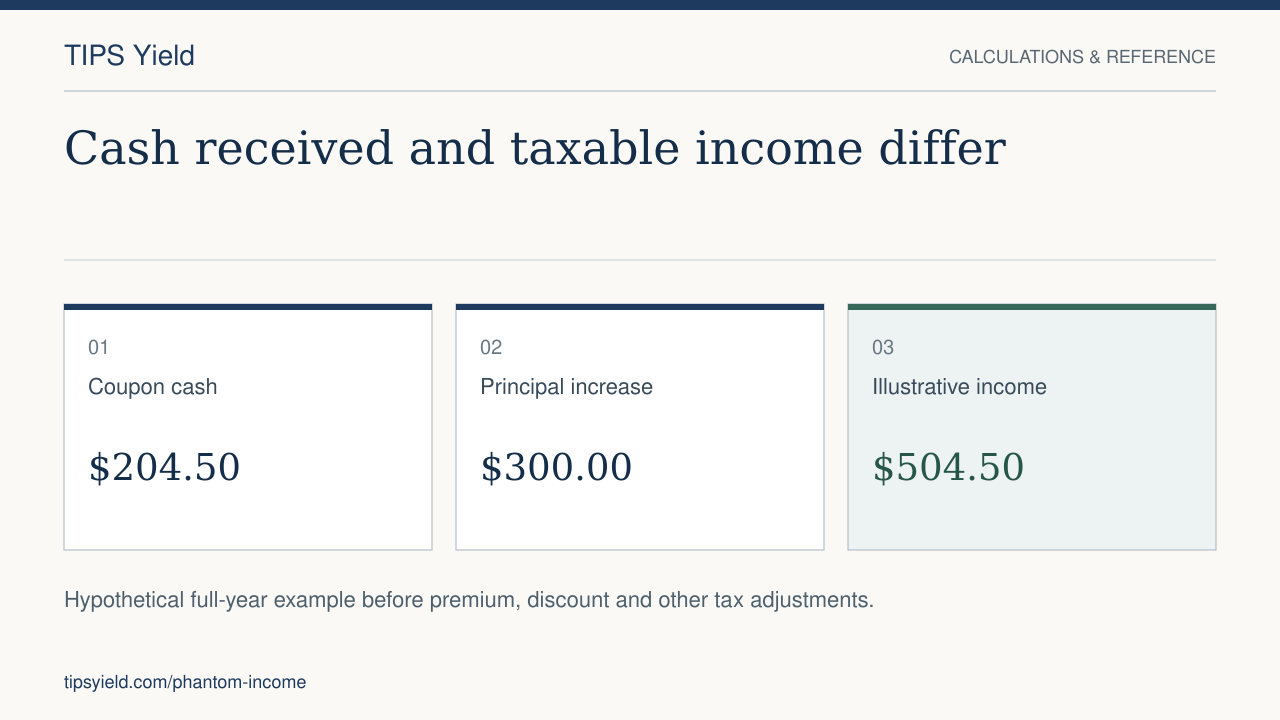
Assume a bond with $10,000 original face amount and a 2% annual coupon is held for the full illustrative year, with no purchase premium or discount. The starting index ratio is 1.00000, the two payment-date ratios are 1.01500 and 1.03000, and the year-end ratio is 1.03000. These assumed ratios simplify the example; they are not actual CPI observations.
| Item | Calculation | Amount |
|---|---|---|
| First coupon | $10,000 × 1.01500 × 2% ÷ 2 | $101.50 |
| Second coupon | $10,000 × 1.03000 × 2% ÷ 2 | $103.00 |
| Coupon cash received | $101.50 + $103.00 | $204.50 |
| Principal increase | $10,000 × (1.03000 − 1.00000) | $300.00 |
| Illustrative income before adjustments | $204.50 + $300.00 | $504.50 |
| Illustrative federal tax at 24% | $504.50 × 24% | $121.08 |
The tax attributable to the principal increase is $72. However, this example's total tax is less than the coupon cash received. Phantom income does not automatically mean the entire tax bill requires outside cash; compare all cash receipts with the actual tax obligation.
With a lower coupon or a larger principal adjustment, the cash mismatch could be more difficult. That is a reason to budget explicitly rather than assume the coupon always pays the tax.
Basis matters too
Taxable OID generally increases your basis. Keeping basis records helps avoid treating previously reported income as a new gain when the bond is sold or redeemed. Secondary-market premium, market discount, partial-year ownership and deflation adjustments can change the calculation. The simple table is not a substitute for reconciling your forms and basis.
IRS Publication 1212 covers inflation-indexed instruments and deflation adjustments. Check how your custodian reports stated interest and OID; do not add the same amount twice merely because it appears in more than one summary.
Taxable account, traditional retirement account or Roth?
| Account | Question to resolve |
|---|---|
| Taxable | Can coupons or other cash cover annual taxes? Are basis records and premium/discount adjustments correct? |
| Traditional IRA or eligible workplace plan | Can the account hold individual TIPS, and how will withdrawals and applicable distribution rules affect spending? |
| Roth account | Do withdrawals meet the rules for qualified treatment, and is this the preferred use of limited account space? |
There is no universal account-placement rule that settles every investor's situation. Available investments, withdrawal timing, tax rates and the rest of the portfolio matter. For account distributions, consult the IRS's IRA distribution guidance and the rules of the particular plan.
State taxes and funds
Direct Treasury interest has a state and local income-tax exemption, but do not assume every component of a sale gain has the same treatment. Fund distributions require the sponsor's annual tax information and applicable state rules. A fund wrapper does not turn every distribution into tax-exempt income.
A TIPS fund can distribute cash differently from an individual bond. Check its distribution schedule and source of income rather than assuming a fixed monthly amount. See funds versus individual TIPS.
Build a tax cash-flow reserve
Record expected coupon dates, review principal adjustments during the year, estimate taxes with the assumptions appropriate to your household, and keep cash accessible before payments are due. If your ladder estimate is pretax, label it that way.
The Phantom Income worksheet provides a place to work through illustrative tax budgeting. The website's ladder calculator does not calculate your personal tax liability.