TIPS funds versus individual TIPS
An individual TIPS has a specified maturity date. A conventional rolling TIPS fund maintains a portfolio over time. Both can provide inflation-linked exposure, but they do not deliver cash on the same schedule.
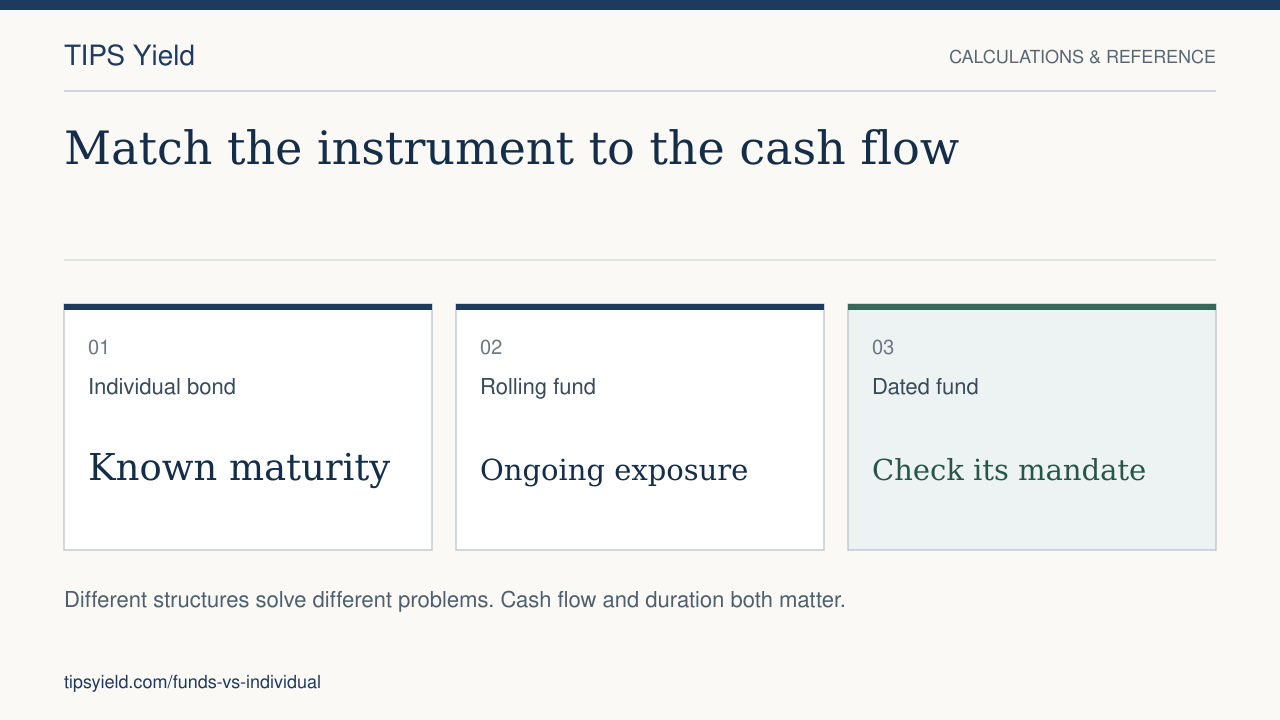
Compare the job before the ticker
| Feature | Individual TIPS ladder | Conventional rolling TIPS fund |
|---|---|---|
| Scheduled principal | Selected bonds repay at their maturity dates | No scheduled repayment of your original investment on a personal spending date |
| Ongoing work | Select bonds, manage cash dates and address missing maturities | Fund manages the portfolio; you manage purchases, sales and distributions |
| Cash between maturities | Semiannual coupons; a cash reserve may be needed | Fund distributions on its stated schedule; amounts vary |
| Value if sold early | Market price, which can be below cost | Share price, which can be below cost |
| Annual expenses | Check brokerage spreads and fees | Expense ratio plus trading spread and any brokerage fees |
Why inflation protection can coexist with a price loss
Inflation adjustments are only one component of a bond's return. If market real yields rise, the present value of existing fixed-coupon cash flows can fall. Longer duration generally means greater price sensitivity.
For a hypothetical duration of six years, a one-percentage-point rise in real yields implies roughly a 6% price decline before considering convexity, carry and other changes. An inflation accrual during the same period does not necessarily offset that decline. This is an illustration, not a forecast or a historical fund-return claim.
Holding an individual bond to maturity avoids having to realize its intervening market price to fund that maturity date. It does not erase tax, liquidity, opportunity-cost or spending-mismatch considerations. A fund investor selling shares to pay a bill is using the share price available at that time.
Defined-maturity funds are a separate category
It is inaccurate to say that no ETF ever matures. Defined-maturity bond ETFs exist; iShares describes its iBonds structure as distributing a final payout in the stated maturity year. The size of that payout is not a promise to return your original purchase price.
Check the actual fund's holdings, inflation protection, fees, termination policy and available years. A category label alone does not establish equivalence to a direct TIPS ladder. These ETFs are also different from Treasury Series I savings bonds.
Two different planning examples
For a known tuition or retirement bill, start by comparing a suitable individual maturity with the date of the expense. For an ongoing bond allocation inside a portfolio, consider how a rolling fund's duration and maintenance needs fit the broader allocation.
Neither choice removes the need for a cash plan. A ladder can have missing maturity years, and a fund can require selling shares during a decline. Review gap-year choices and tax cash flows.
Next steps
Use the worked ladder example for date-specific spending. For fund exposure, compare TIPS ETFs by mandate and duration, then examine SCHP versus VTIP. Do not choose only by the largest displayed distribution yield.