TIPS ladder gap years
A spending year in a calculator does not guarantee there is an outstanding bond maturing that year. The current calculator flags 2037, 2038 and 2039 as hypothetical rungs. Before placing orders, compare your plan with the dated Treasury maturity inventory.
Why a gap exists
Issuance history and the terms Treasury offers determine which maturity dates exist. New ten-year issues gradually extend the nearer part of the calendar, while older longer-dated issues cover later years. A missing year is a security-availability problem, not a missing cell to fill with a made-up quote.
Under the current issuance pattern, ten-year issues in 2027–2029 would provide maturities in 2037–2039. That is an expectation based on the pattern, not a guarantee of future issuance or yield. Use actual Treasury announcements when they become available.
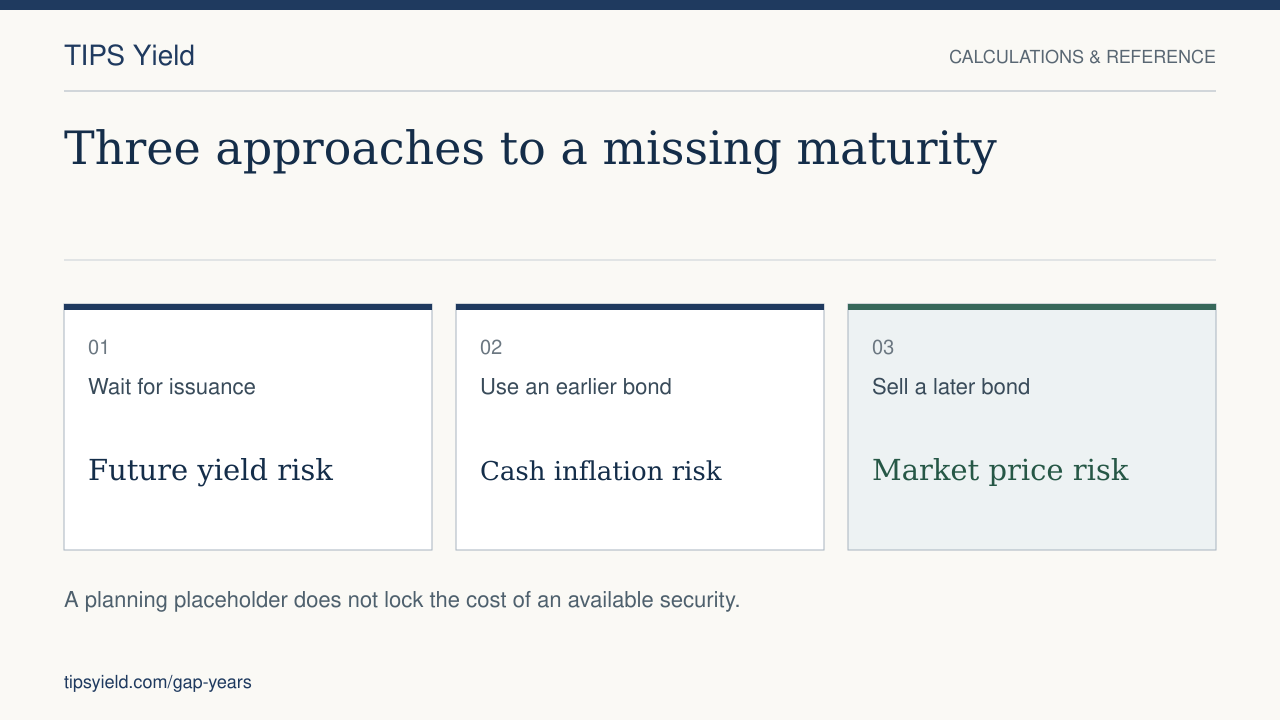
Three ways to plan for a missing year
| Approach | Cash-flow mechanism | Uncertainty that remains |
|---|---|---|
| Reserve for future purchases | Hold earmarked funds and purchase a suitable security if issued later | Future real yield, available issue terms and return on the reserve |
| Earlier maturity plus a cash bridge | Receive principal before the spending year, then hold or reinvest it until needed | Inflation and reinvestment rates during the bridge period |
| Later bond with planned sale | Sell some of a later-maturing holding in the spending year | Market price, spread and taxes at the time of sale |
A $40,000 gap-year example
Suppose the plan needs $40,000 in today's purchasing power during 2038. A 2036 maturity pays before that need; its proceeds must bridge the intervening period. A 2040 maturity pays after the need; it cannot directly fund the earlier bill without a sale or another funding source.
For a simplified two-year cash bridge, $40,000 of purchasing power would require $42,436 of nominal cash if inflation were 3% annually: $40,000 × 1.03². This hypothetical illustration ignores the return earned on the reserve and taxes. If both nominal cash returns and inflation differ from the assumptions, the funding result changes.
For the later-bond approach, an unchanged face amount does not imply a known 2038 sale value. Read the early-sale example before treating that route as equivalent to holding a matching maturity.
How the calculator treats these years
The estimate includes a cost for each gap-year target, using the same interpolated reference-yield and par-purchase assumptions as other rows. It flags the row so it is not confused with an available bond. It does not execute any of the three strategies above or lock a future purchase yield.
See the methodology. A plan with a funded numerical placeholder still needs a real funding decision.
Document the choice
For each gap year, record the spending target, designated reserve or holding, expected cash dates, assumed return and inflation, and the event that triggers a review. Revisit availability after relevant auctions and whenever the spending need changes.
The Gap Years worksheet can help organize these choices. Start with the cash-flow walkthrough if you have not yet sized the rest of the ladder.